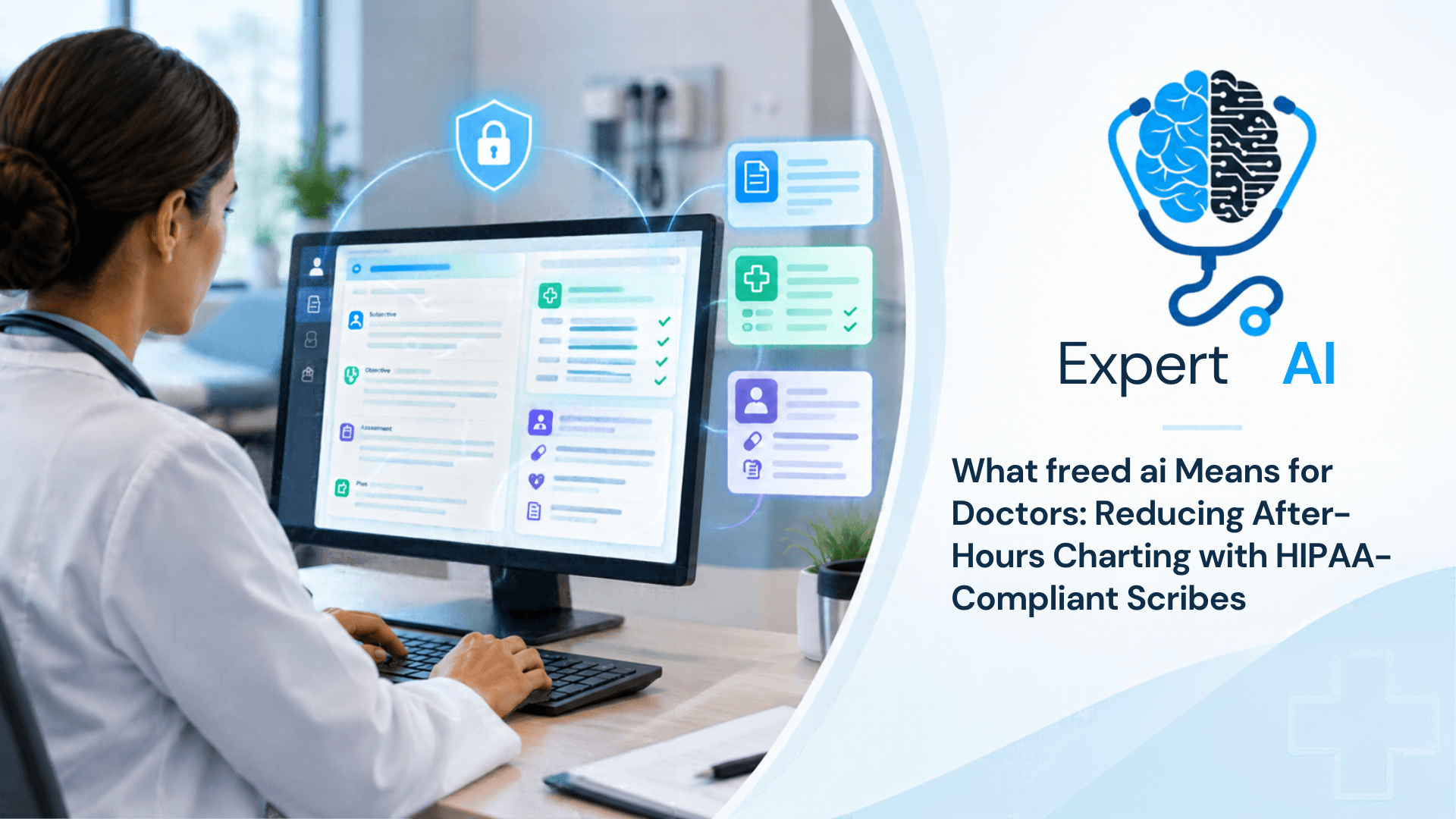
Freed AI, in clinical practice, means one thing: documentation that writes itself while you focus on the patient. You speak, the AI listens, and a structured SOAP note is ready before you move to the next exam room. For primary care physicians, 2026 data from Tebra show they spend roughly three hours per day on clinical documentation. For nurse practitioners, the same data report approximately 4.8 hours per week of after-hours charting. Tools built on this ambient scribing approach have fundamentally changed how the workday ends. Expert AI is designed to bring this workflow to clinicians across in-person and telehealth settings who can no longer afford to give their evenings to the EHR.
This article covers what Freed AI actually delivers, what Freed.ai specifically gets right and where it falls short, how Expert AI compares as a HIPAA-compliant clinical documentation alternative, and what you should verify before committing to any ambient scribe platform. You'll also get concrete numbers on time saved and coding accuracy so you can judge the ROI clearly.
Key Takeaways
- Documentation burden is real: Primary care physicians spend roughly three hours per day on clinical documentation, according to 2026 data from Tebra.
- Freed.ai has solid compliance credentials: SOC 2 Type 1 and Type 2 certifications, AES-256 encryption, U.S.-based hosting, and BAAs for covered entities are genuine baseline safeguards.
- Independent accuracy validation is thin: We found no peer-reviewed clinical study that specifically measures Freed's documentation accuracy or hallucination rate; clinician review remains necessary.
- Expert AI goes further: Built by a practicing Family Nurse Practitioner, it adds automated ICD-10 suggestions, adaptive learning, and multilingual support beyond basic transcription.
- EHR integration is simpler than it sounds: A Chrome extension handles most browser-based EHRs with no IT or API setup required.
How Ambient Scribing Actually Changes a Primary Care or Telehealth Day
Primary care physicians spend roughly three hours per day on clinical documentation, according to 2026 data from Tebra. That's not an inconvenience; it's a structural problem that pushes note-writing into evenings and weekends. Ambient scribing breaks the cycle by capturing the encounter in real time and generating the note automatically. The clinician's role shifts from author to editor, a fundamentally different cognitive load and a much lighter one.
The math is straightforward. Across 20 or 25 patients a day, that compression adds up to hours of reclaimed time, not minutes.
Telehealth encounters carry a specific documentation trap: the clinician is already on a screen, often toggling between the video call, the EHR, and a separate note-taking tool. Ambient clinical scribes eliminate that toggle entirely. The AI transcribes the virtual visit in real time, structures it into SOAP format, and queues it for review within the same session. For practices running high volumes of virtual appointments, that compression compounds week over week into a meaningful return of clinical capacity. Our telehealth documentation checklist covers what every virtual visit note needs.
Is Freed.ai HIPAA-Compliant Enough for Your Practice?
Freed holds SOC 2 Type 1 and Type 2 certifications, encrypts PHI with AES-256 at rest and TLS 1.2 to 1.3 in transit, and stores data exclusively in U.S.-based Microsoft Azure environments. It offers BAAs for covered entities as part of its standard sign-up, and its stated policy is that it does not use identifiable patient recordings or notes to train AI models. Those are solid baseline credentials for a HIPAA-compliant AI scribe, and they should be verified against your own compliance requirements before you go live.
Understanding "HIPAA-Compliant" in Practice
"HIPAA-compliant" is not a certification and does not guarantee compliance for every configuration. Freed's subprocessors include OpenAI, Anthropic, Baseten, and Fireworks. Those handling PHI operate under BAAs with zero-data-retention and no-training requirements. Before signing, confirm that all named subprocessors are covered and that audio is deleted after note generation rather than retained indefinitely. Verify that the executed BAA aligns with how your practice actually uses the tool. Our guide to whether AI transcription is HIPAA compliant lists what to check.
Where Freed falls short is validation, not compliance. We could not find a peer-reviewed clinical study that independently measures Freed's documentation accuracy, hallucination rate, or omission rate. Its accuracy claims rest on user reviews and vendor-published case studies, not controlled benchmarks. Users report occasional invented exchanges during silent portions of recordings and missed details in complex encounters. Freed functions as a capable documentation assistant. It is not an autonomous recorder, and clinicians in high-acuity or high-liability specialties should treat that distinction seriously.
How Freed AI Compares: Freed.ai, Suki, Notable, and Augmedix
Freed.ai sits in a competitive field that includes Suki, Notable, and Augmedix, among others. Each platform takes a different approach to ambient scribing. Suki emphasizes voice commands for structured data entry alongside transcription. Notable focuses on automating pre-visit and post-visit workflows in addition to documentation. Augmedix positions itself primarily for hospital and enterprise health system deployments. Freed.ai targets independent and small-group practices with a lightweight setup and straightforward pricing.
What most of these platforms share is the same core gap: limited independent accuracy validation. Few ambient scribe tools have independent, peer-reviewed benchmarks measuring hallucination or omission rates under controlled clinical conditions. Clinician review is necessary regardless of which platform you choose. The practical differentiators come down to EHR compatibility, multilingual support, specialty-specific note formats, and what additional outputs the platform generates beyond the SOAP note itself.
A Quick Freed Scribe Review: What Users Actually Report
Freed AI scribe reviews from practicing clinicians are generally positive about speed and ease of setup. Common praise centers on how quickly the tool produces a usable draft and how little IT involvement the onboarding requires. Common criticisms include hallucinated content during pauses in conversation, inconsistent performance in complex or high-acuity encounters, and limited specialty-specific customization. For straightforward primary care workflows, most users find Freed.ai delivers on its core promise. For practices with more complex documentation requirements, the limitations become more noticeable over time.
Why Expert AI Takes the Ambient Scribing Approach Further
Expert AI was developed by a practicing Family Nurse Practitioner who experienced the documentation burden firsthand. That origin shapes how the software works. Beyond transcription, it generates structured SOAP notes and automatically suggests relevant ICD-10 diagnosis codes at the end of each encounter. It also delivers post-visit patient instructions ready to email directly to the patient.
The combination of ambient capture and automated coding is where Expert AI separates itself from simpler transcription tools. When the encounter ends, the clinician already has a draft note and a coding suggestion waiting, not a blank template to fill in from memory. Expert AI also learns each clinician's documentation style over time, so drafts become more accurate and require fewer edits week over week. The tool gets more useful the longer you use it, not less.
Multilingual Support and Linguistic Diversity
Expert AI supports over 80 languages and regional dialects. That matters significantly for multilingual primary care and telehealth settings. A MedRxiv analysis of AI scribes in linguistically diverse health systems found that non-English encounters were 21 to 25% less likely than English encounters to meet the same documentation-performance threshold in a large safety-net health system. Expert AI transcribes the encounter in the patient's language and produces the clinical note in standardized American English, keeping documentation compliant without slowing the visit. That capability is not universal among AI medical scribe software, and it's a material difference for any practice serving diverse communities.
How to Connect Expert AI with Your EHR
Most clinicians assume EHR integration requires IT involvement, vendor contracts, and weeks of setup. For browser-based EHRs, it doesn't. Expert AI integrates through a Chrome extension that places the note directly into the correct fields without requiring API access or technical configuration. Expert AI integrates with browser-based EHRs via a Chrome extension or a copy-paste workflow.
- Install the Chrome extension for Expert AI in your browser.
- Open your EHR in the same browser session.
- Begin the patient encounter and start ambient recording within the scribe interface.
- At the end of the visit, review the generated SOAP note and ICD-10 code suggestions.
- Use the one-click transfer function to push the note into the appropriate EHR fields.
- Edit, approve, and sign within your normal EHR workflow.
For EHRs that don't support direct push, a copy-paste workflow requires no technical setup. Expert AI's integration is EHR-agnostic by design, which means specialty practices and clinics using less common platforms aren't locked out.
The integration process is consistent across specialties, but the note structure adapts. Expert AI supports specialty-specific documentation formats and adjusts to terminology used in fields like urgent care, behavioral health, and internal medicine. The software doesn't force a one-size template onto a cardiology note or a psychiatric evaluation; it adapts to what the encounter actually requires.
What Outcomes Can You Realistically Expect?
The consistent finding across user reports is that ambient scribes shift clinicians from writing notes from memory to reviewing and lightly editing generated drafts, which is a shorter and less cognitively demanding task.
On coding accuracy, manual coding is error-prone: a 2025 systematic review of automated coding research reports manual coding accuracy ranging from 50% to 98%, with a median of about 80%. AI-assisted coding suggestions address that gap by flagging relevant codes at the point of encounter rather than leaving it to recall or a separate billing review step. The evidence on AI coding accuracy is variable across systems, so testing the tool against your own encounter types before full deployment is the right approach, not an assumption that any AI system automatically outperforms your current process.
Compliance Verification Before You Sign
Before committing to any ambient scribe platform, confirm that the vendor has executed a BAA, that PHI-processing subprocessors are named and covered under their own BAAs, and that audio is deleted after note generation rather than retained indefinitely. For multilingual practices, test the tool on your actual patient demographics. For specialty practices, verify that the note format matches what your EHR and billing team expect, not just what the demo shows. The difference between a tool that looks good in a trial and one that holds up across six months of real volume is almost always in those details.
The Bottom Line on Freed AI for Your Practice
Freed AI is a concept before it's a product: clinical documentation shouldn't consume a clinician's personal time. The tools that deliver on that concept, Freed.ai among them, have genuine value for primary care and telehealth workflows. But Freed.ai still requires thorough clinician review, lacks independent accuracy validation, and may not cover every EHR format or specialty workflow your practice depends on.
Expert AI was built to close those gaps. It combines ambient scribing, automated ICD-10 suggestions, multilingual support, post-visit patient instructions, and adaptive learning into a HIPAA-compliant AI medical scribe developed by a clinician who built it to solve a real documentation problem. The ROI calculation is favorable: if ambient scribing saves even one hour of after-hours charting per day, the value recovered far exceeds the cost of the tool.
The real question is which implementation fits your workflow, your EHR, your patient population, and your compliance requirements. Schedule a live session with Expert AI against your actual encounter types before you commit to anything.
Frequently Asked Questions
Will Freed.ai remove the need for clinicians to review notes after encounters?
No, clinicians still need to review notes generated by Freed.ai. The platform can produce usable drafts quickly, but users report occasional hallucinated content and missed details in complex encounters, so clinician review remains necessary to ensure accuracy and patient safety.
Is Freed.ai appropriate for high-acuity or specialty care settings?
Freed.ai may be less reliable for high-acuity or complex specialty encounters. Users report inconsistent performance in those situations and missing details, so practices with higher liability or complexity should treat it cautiously and verify suitability before full deployment.
What specific checks should you run during a trial of an ambient scribe before committing?
You should confirm an executed BAA that names and covers all PHI-processing subprocessors, verify that audio is deleted after note generation, test the tool on your actual patient demographics for multilingual support, and validate that the note format matches your EHR and billing team requirements. Those checks reveal whether the tool will hold up across real volume and specialty needs rather than just during a demo.
Ready to Try Expert AI?
Join thousands of healthcare providers streamlining their documentation with AI-powered transcription. Start your free trial today.
Get Started Free →